Quantum, now visible: the 2025 Nobel and the tunneling that built the qubit
Quantum mechanics was supposed to be the physics of the very small, a rulebook for electrons and photons that politely stopped mattering somewhere around the size of a dust mote. On October 7, 2025, three physicists won the Nobel Prize for showing that a circuit you can hold in your hand can tunnel through a wall it has no classical right to cross.
The wall between the quantum and the everyday
Quantum objects do two things that classical ones simply cannot. They tunnel: a particle can pass through an energy barrier it lacks the energy to climb over, appearing on the far side of a wall it should have bounced off. And their energies are quantized: rather than taking any value on a continuous dial, a confined quantum system occupies only a discrete ladder of allowed levels, with the rungs between them forbidden. We never watch a thrown ball melt through a brick wall, and we never see a playground swing restricted to certain fixed energies and nothing in between. Somewhere between the electron and the everyday, the strangeness seems to switch off. A dust mote already behaves, for all practical purposes, like a classical speck. Where exactly it switches off, and why, is one of the oldest open questions in the theory. The 2025 laureates addressed it not by shrinking their apparatus down toward the atomic scale but by scaling the strangeness up, into an electrical circuit large enough to see and to wire into a lab bench.
A quantum degree of freedom you could wire up
The laureates are John Clarke of UC Berkeley, Michel H. Devoret of Yale, UC Santa Barbara and Google Quantum AI, and John M. Martinis of UC Santa Barbara and Qolab; they did the defining experiments in the 1980s at Berkeley. Their apparatus was built around a Josephson junction: two superconductors, each carrying vast numbers of electrons in perfect lockstep and without resistance, separated by a thin insulating barrier. The trick was to engineer the circuit so that a single collective variable (one number describing the state of the entire system, not the position of any individual particle within it) behaved as one clean quantum degree of freedom. That is the conceptual leap: not a lone atom held in a trap, and not a stray electron, but a fabricated electrical component, visible and connectable, coaxed into acting as a single quantum object obeying the same equations an atom does.
Two discoveries in one circuit
What the circuit then did is captured, word for word, in the official citation: “for the discovery of macroscopic quantum mechanical tunnelling and energy quantisation in an electric circuit.” Two effects, in one device. First, macroscopic quantum tunnelling: the circuit escaped through an energy barrier it could not classically surmount, the entire system passing through the wall at once rather than any single particle sneaking across. Second, energy quantisation: measured carefully, the circuit was found to occupy only discrete energy levels, a rung-by-rung ladder of exactly the kind a single atom displays. A system large enough to hold in the palm of a hand was obeying the rules supposedly reserved for the very small. The quantum-to-classical boundary, it turned out, was not pinned at the size of an atom; it could be pushed outward, deliberately, with sufficiently careful engineering.
From artificial atom to qubit
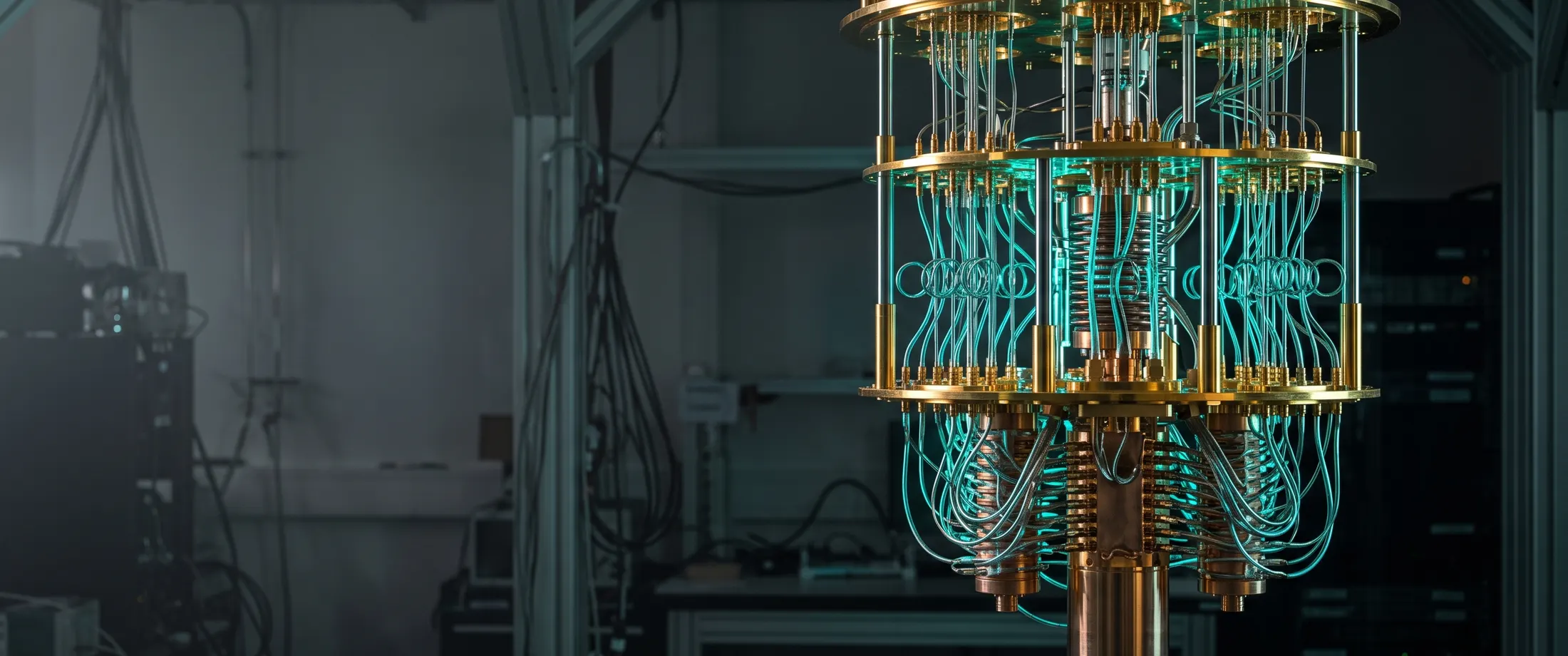
An engineered circuit with a discrete ladder of energy levels is, functionally, an artificial atom, but one you can design, tune, and fabricate rather than merely accept from nature. Isolate its two lowest levels and you have a controllable two-state quantum system: a qubit. Unlike a classical bit fixed at 0 or 1, a qubit can be placed in a superposition of both at once, the property from which quantum computing draws its power. This is the through-line from a 1980s physics demonstration to a present-day industry. The laureates’ experiments laid the groundwork for the superconducting qubit, now one of the leading hardware platforms for quantum computing. Those 1984 and 1985 circuits were built to test a physical principle, and the principle became the qubit: Martinis himself went on to build one, using exactly the energy quantisation the three of them had demonstrated. Two of the laureates hold industry posts today, Devoret as chief scientist for quantum hardware at Google Quantum AI and Martinis as chief technology officer at Qolab. Roughly forty years separate the demonstration from the devices it made conceivable.
The same trick, from the Sun to the transistor
Tunnelling itself is not rare or delicate; it is everywhere, usually unremarked. It is the same quantum effect that lets hydrogen nuclei in the Sun’s core fuse despite the electrical repulsion that should keep them apart (without it, the Sun would not shine), and the same effect that leaks charge across the ever-thinner insulating gaps inside shrinking transistors, where chip designers treat it as a nuisance to be suppressed. What sets the laureates’ work apart is intent. They did not exploit tunnelling incidentally, as a star does, nor fight it, as a processor must. They built a large, deliberate object whose tunnelling and quantized levels were the entire point, and then measured them cleanly enough to leave no room for a classical explanation.
Where the line really sits
The experiments did not abolish the boundary between quantum and classical so much as relocate and clarify it. The lesson is that quantumness is not a simple matter of size. What suppresses quantum behavior in everyday objects is their constant, uncontrolled interaction with a warm and noisy environment, which scrambles the delicate relationships a quantum state depends on; a system engineered to stay isolated and undisturbed can be macroscopic and quantum at the same time. That is the real gift behind the hardware: the reason a circuit fabricated on a chip can, in the right conditions, be as quantum as an atom, and can be held there long enough to compute with. The prize honors a demonstration that the weird rules were never confined to the small. They were only ever confined to the undisturbed.
Sources / further reading
- NobelPrize.org, The Nobel Prize in Physics 2025 press release: https://www.nobelprize.org/prizes/physics/2025/press-release/
- NobelPrize.org, popular science background, “Quantum properties on a human scale”: https://www.nobelprize.org/prizes/physics/2025/popular-information/
- Yale News, “Yale’s Michel H. Devoret wins 2025 Nobel Prize in Physics” (Oct 7, 2025): https://news.yale.edu/2025/10/07/yales-michel-h-devoret-wins-2025-nobel-prize-physics
- University of California, “Nobel Prize in physics awarded to 3 University of California faculty”: https://www.universityofcalifornia.edu/news/nobel-prize-physics-awarded-3-university-california-faculty
Written by Ashwin Rajendraprasad for CloudSignal AI.