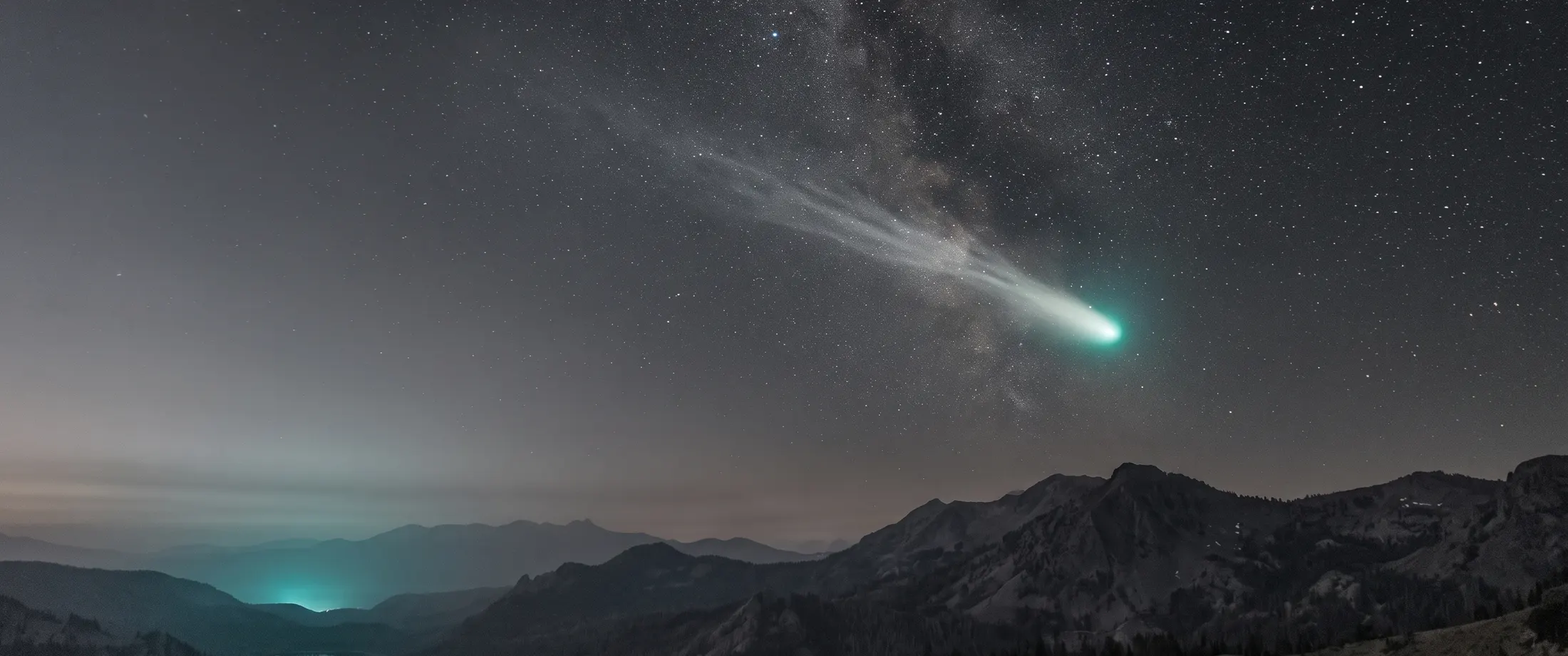
A visitor from beyond: what comet 3I/ATLAS is (and isn't)
On July 1, 2025, a survey telescope caught a faint smudge of light moving too fast to belong to our Sun. It turned out to be only the third object ever confirmed to have arrived from another star. On the evidence, it is an ordinary comet, which is close to the most remarkable thing it could have been.
Three visitors in a decade
For the whole of recorded history, every comet and asteroid we tracked belonged to the Sun, born from the same disk of gas and dust that made the planets. That changed only recently, and only three times. In 2017 came 1I/ʻOumuamua, the first object confirmed to be interstellar, a strange elongated body that was gone almost before we understood it. In 2019 came 2I/Borisov, which looked reassuringly like a familiar comet. And now, in 2025, comes 3I/ATLAS, discovered by the ATLAS survey on July 1 and confirmed as the third known visitor from beyond our planetary system. The “I” in each name is a designation, not a decoration: it marks the object as interstellar, a traveler that formed somewhere else and is merely passing through on a road that does not loop back.
How we know it isn’t ours
The proof is written in the orbit. Anything gravitationally bound to the Sun traces a closed ellipse, returning again and again over years or millennia. 3I/ATLAS does not: it is on a strongly hyperbolic trajectory, an open path, moving faster than the Sun’s gravity can hold at its distance. It fell in from interstellar space, will swing once around the Sun, and will depart for interstellar space again, never to return. That single geometric fact, the shape and speed of a path reconstructed from night after night of position measurements, is what certifies an origin outside the solar system. No exotic explanation is required to reach that conclusion, and none is admitted by the data; the trajectory alone does the work.
An ordinary comet, extraordinarily far from home
What 3I/ATLAS is, beyond interstellar, is a comet, and an active one. As it approached the Sun and warmed, it developed a coma, the diffuse envelope of gas and dust that gives comets their fuzzy look, and it shed material into space, exactly the behavior of an icy body heating up. It reached perihelion, its closest approach to the Sun, in late October 2025, and it drew sustained observation from NASA, ESA, the James Webb Space Telescope, and other facilities working to characterize its composition. Strip away the novelty of its address and it is a familiar kind of object: a dirty snowball, a fossil of planet-building left over from the system where it formed. The extraordinary part is only that it formed around another star and has drifted for an unknown span of time (possibly billions of years, through the cold between the stars) before crossing our small patch of the galaxy at just the moment we had the telescopes to catch it.
Evidence first
A genuine interstellar visitor attracts real science and, inevitably, a good deal of speculation, including the recurring suggestion that such an object might be artificial, a probe rather than a rock. The rule that settles the matter is traceable to the sociologist Marcello Truzzi in 1978 and was carried into wide use by Carl Sagan: extraordinary claims require extraordinary evidence. The evidence for 3I/ATLAS points, consistently and from multiple observatories, to a natural comet. Its coma, its outgassing, and its trajectory are exactly what an icy body should produce and exactly what an artifact need not. Wonder is not opposed to rigor here; the wonder is what rigor delivers. The honest reading is a comet from another solar system, seen in the act of passing through ours. That reading is also the more astonishing one, and it does not need embellishing to earn its place among the notable events of the year.
Where is everybody?
And yet a rock from another star cannot help but raise an older question. Around 1950, over lunch, the physicist Enrico Fermi is said to have posed it in three words: “Where is everybody?” The reasoning behind the quip is serious. The galaxy is vast and very old; if life, and eventually technology, are at all common, then across billions of years the evidence ought to be widespread (probes, signals, some trace of other minds), and we see none of it. That mismatch between a plausibly crowded galaxy and an apparently silent one is the Fermi paradox, and it remains a genuinely open problem rather than a solved one, a question science can state precisely and cannot yet answer. Notice, in that light, precisely what did arrive from interstellar space this year. Not a signal, not a probe, not a message. A comet.
Answers we don’t have
The proposed resolutions of Fermi’s question are hypotheses, not conclusions, and it would be a mistake to treat any of them as settled. Perhaps life is simply rare, and the galaxy is quieter than our optimism assumes. Perhaps there is a “Great Filter” (a framing due to the economist Robin Hanson): some improbable step on the long road from lifeless chemistry to a galaxy-spanning civilization that almost everything fails to pass, whether that hurdle lies safely behind us or somewhere ahead. Perhaps the distances are just too great, or the civilizations too short-lived or too quiet, for anyone ever to notice anyone else. Nothing about 3I/ATLAS decides among these possibilities; it neither shows that we are alone nor that we are not. What it does show is concrete and worth keeping: other star systems really do send their debris our way, our instruments can now catch it mid-passage, and the raw material of planets forms around other stars as it did around ours. That, for the moment, is the whole of the headline — and it is plenty.
Sources / further reading
- NASA, Comet 3I/ATLAS: https://science.nasa.gov/solar-system/comets/3i-atlas/
- ESA, Comet 3I/ATLAS frequently asked questions: https://www.esa.int/Science_Exploration/Space_Science/Comet_3I_ATLAS_frequently_asked_questions
- SETI Institute, “Comet 3I/ATLAS: A Visitor from Beyond the Solar System”: https://www.seti.org/news/comet-3iatlas-a-visitor-from-beyond-the-solar-system/
- Fermi paradox (overview): https://en.wikipedia.org/wiki/Fermi_paradox
- Great Filter (Robin Hanson): https://en.wikipedia.org/wiki/Great_Filter
Written by Ashwin Rajendraprasad for CloudSignal AI.