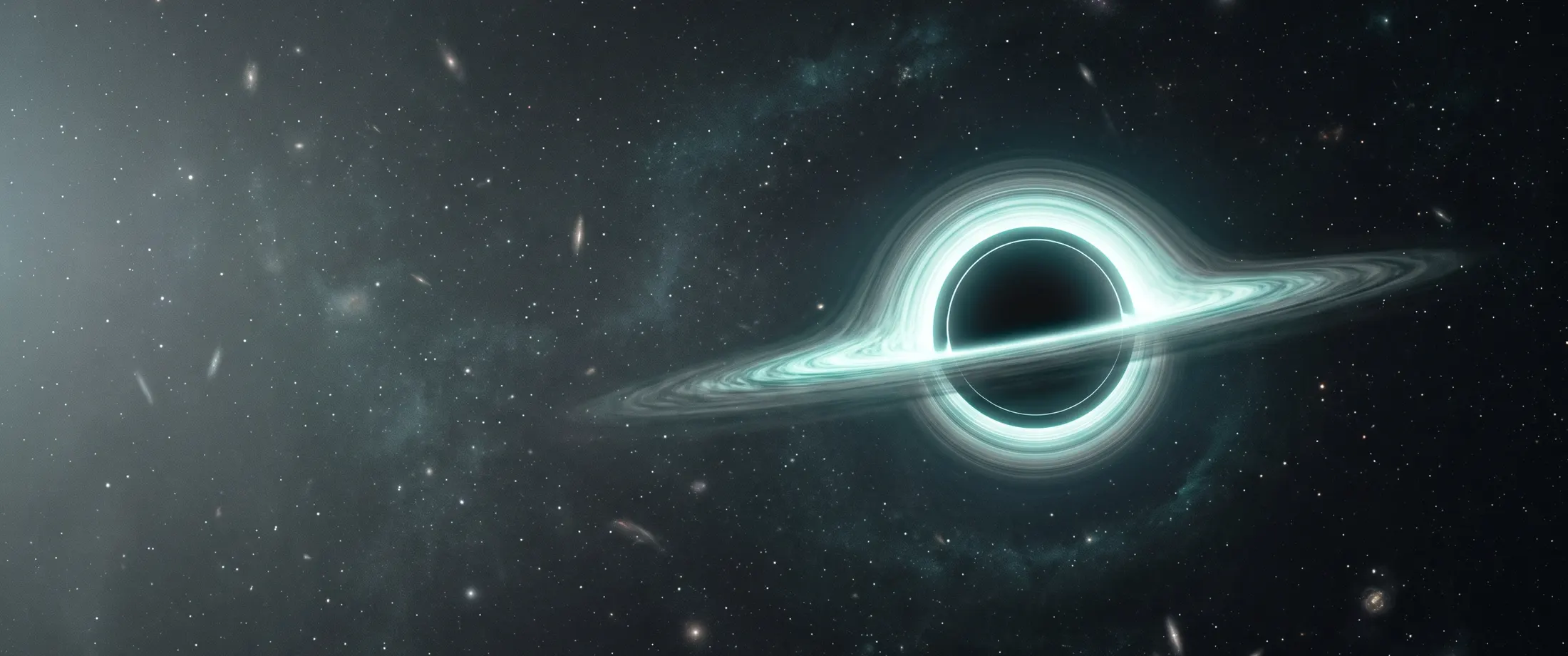
The universe's strictest filing system: black holes and information
Black hole entropy scales with the area of the horizon, not the volume it encloses. That single fact (odd enough to stop you the first time you meet it) set off one of the deepest arguments in modern physics: whether the universe is capable of destroying information, and if not, where it hides it.
An entropy that lives on the surface
In 1972, Jacob Bekenstein argued that a black hole must carry entropy, or else dropping a hot cup of tea past the horizon would let you violate the second law of thermodynamics by simply hiding the disorder. The entropy he proposed, later sharpened by Stephen Hawking, is the Bekenstein–Hawking entropy:
S_BH = k_B c³ A / (4 G ℏ)
The striking feature is A: the area of the event horizon, not the volume inside. Divide that area into tiles of one Planck area (ℓ_P² = Gℏ/c³ ≈ 2.6 × 10⁻⁷⁰ m²), and the entropy is essentially one quarter of the tile count. A black hole the mass of the Sun carries an entropy of order 10⁷⁷ k_B, which vastly exceeds the entropy of the star it formed from. Information, it seems, is written on the surface.
Then Hawking made it worse
If a black hole has a temperature, it must radiate. In 1974, Stephen Hawking showed it does: a faint thermal glow now called Hawking radiation, at a temperature
T_H = ℏ c³ / (8 π G M k_B)
Note the inverse dependence on mass: small black holes are hotter and evaporate faster; giant ones are colder than empty space. And here is the crisis. Hawking’s radiation is thermal, featureless, depending only on mass, charge, and spin. If a black hole can evaporate away entirely into featureless radiation, then whatever fell in (a library, a star, the tea) appears to be erased. But quantum mechanics forbids that: its bookkeeping (unitarity) insists information is never destroyed. This is the black hole information paradox, and it went unresolved for decades.
A resolution, and the argument inside it
The first real crack came in 1996, when Andrew Strominger and Cumrun Vafa counted the microscopic quantum states of a specific class of black holes using D-branes in string theory, and recovered exactly the Bekenstein–Hawking value, the famous factor of A/4 included. The entropy wasn’t a formal analogy; it was counting real microstates, just as thermodynamic entropy always had.
That reframing pointed at something larger. Gerard ‘t Hooft and Leonard Susskind proposed the holographic principle: the full physics inside a region can be encoded on its boundary, one dimension down. The universe as a hologram. Juan Maldacena then gave the idea a concrete mathematical home with the AdS/CFT correspondence, a conjectured dictionary between a theory of gravity in a volume and an ordinary quantum theory living on its lower-dimensional edge. The conjecture has survived decades of tests without being proved, and the gravity side of it lives in anti-de Sitter space, a negatively curved cosmos that is not the one we inhabit. Where the dictionary applies, information falling into a black hole is re-encoded on the boundary rather than erased, in a scrambled form we don’t yet know how to read.
What that adds up to is narrower than the headlines suggest. Physicists now broadly agree that information survives a black hole’s evaporation. They do not agree on how: views still differ over precisely which part of Hawking’s semiclassical calculation needs correcting, and the candidate mechanisms remain live proposals rather than settled results.
Information is physical
Underneath all of this sits a principle from Rolf Landauer: information is physical. Erasing a bit has a minimum thermodynamic cost (k_B T ln 2 of energy), which ties abstract information directly to heat and entropy, the same currency black holes trade in. That is why a paradox about information turned out to be a paradox about thermodynamics and gravity at once, and why its resolution reached so far into fundamental physics.
The best answer we have is that the universe never loses a bit. It files it somewhere you can’t read — one quarter of a horizon at a time. How the filing works is the part still being argued.
Sources / further reading
- Bekenstein, “Black Holes and Entropy,” Phys. Rev. D 7, 2333 (1973): https://journals.aps.org/prd/abstract/10.1103/PhysRevD.7.2333
- Hawking, “Particle Creation by Black Holes,” Commun. Math. Phys. 43, 199 (1975): https://link.springer.com/article/10.1007/BF02345020
- Strominger & Vafa, “Microscopic Origin of the Bekenstein–Hawking Entropy” (arXiv:hep-th/9601029): https://arxiv.org/abs/hep-th/9601029
- Maldacena, “The Large-N Limit of Superconformal Field Theories and Supergravity” (arXiv:hep-th/9711200): https://arxiv.org/abs/hep-th/9711200
- ‘t Hooft, “Dimensional Reduction in Quantum Gravity” (arXiv:gr-qc/9310026): https://arxiv.org/abs/gr-qc/9310026
- Susskind, “The World as a Hologram” (arXiv:hep-th/9409089): https://arxiv.org/abs/hep-th/9409089
- Landauer, “Irreversibility and Heat Generation in the Computing Process,” IBM J. Res. Dev. 5, 183 (1961): https://www.cs.princeton.edu/courses/archive/fall06/cos576/papers/landauer61.pdf
- Black hole information paradox (overview): https://en.wikipedia.org/wiki/Black_hole_information_paradox
Written by Ashwin Rajendraprasad for CloudSignal AI.