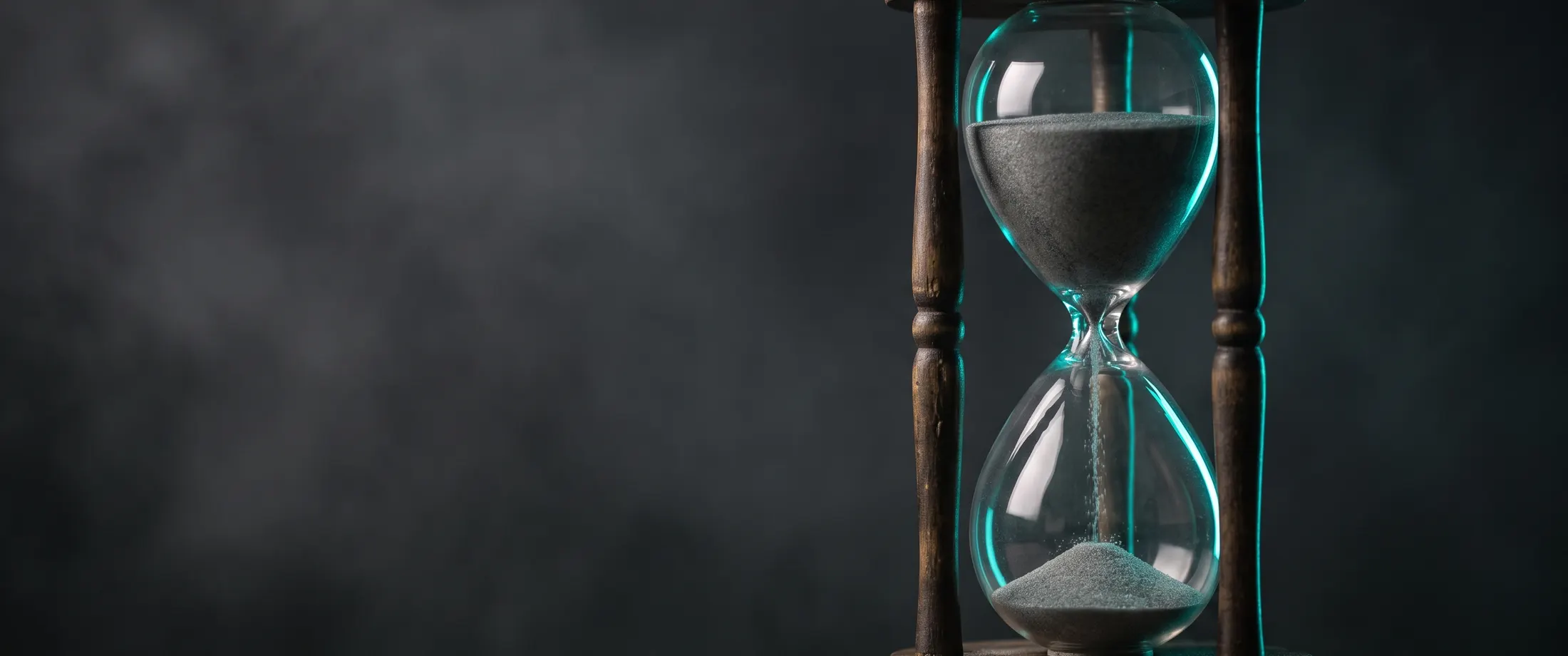
The arrow of time: why the future looks different from the past
Almost every fundamental law of physics runs identically forwards and backwards, and yet cups shatter and never reassemble. The entire one-way character of time traces to a single idea — entropy — that links the most ordinary experience to the largest scales of the cosmos.
A rulebook that doesn’t care which way time runs
Write down the fundamental laws of motion (Newton’s mechanics, Maxwell’s electromagnetism, the equations of quantum mechanics) and you find they share a strange indifference: each works equally well with time running either direction. Film two billiard balls colliding and play the reel backwards, and the reversed collision is still perfectly legal physics; nothing in the equations stamps one direction as “forward.” Yet nothing in ordinary life is remotely so even-handed. A dropped cup shatters and the shards never leap back together. Heat flows from hot to cold and never, unaided, the other way. We remember the past and not the future. If the microscopic rulebook makes no distinction between before and after, where does the glaring one-way arrow of experience come from?
Entropy, plainly
The answer is entropy, and its core is a matter of counting. Any large-scale description of a system, say the temperature and pressure of the air in a room, can be realized by an enormous number of different microscopic arrangements of the underlying particles. Entropy is essentially a tally of those arrangements: how many distinct microscopic configurations look identical from the outside. Ludwig Boltzmann captured it in one of the most consequential formulas in physics, later carved on his gravestone:
S = k log W
Here S is the entropy, W is the number of microscopic arrangements (microstates) that correspond to the same large-scale state, and k is Boltzmann’s constant, the factor that converts a raw count into thermodynamic units. A situation you can build in vastly more ways has higher entropy. That is the whole of it: entropy measures how many ways the small-scale details can be reshuffled without changing the big picture. Entropy turns up wherever disorder and heat meet, famously including the surfaces of black holes, which carry a staggering amount of it.
Why the arrow points forward
Once entropy is seen as counting, the second law of thermodynamics (that the total entropy of an isolated system does not decrease) stops being a mysterious decree and becomes nearly a truism. Systems drift toward higher-entropy states not because low-entropy states are outlawed, but because high-entropy states are overwhelmingly more numerous. Shuffle a deck and it comes out disordered, not because order breaks a rule but because there is a single sorted arrangement and astronomically many jumbled ones. A cup’s worth of intact ceramic is one exquisitely special configuration of atoms; the shards-and-dust version can be assembled in countless ways. Stir a drop of ink into a glass of water and it spreads until the whole glass is uniformly grey, never regathering into a single drop, for exactly the same reason: the mixed state can be realized in overwhelmingly more ways than the separated one.
So the arrow of time is simply the direction of overwhelming statistical probability. Reversal is not forbidden; a shattered cup spontaneously reassembling would violate no law of motion. It is merely so staggeringly unlikely that across the entire age of the universe you would never expect to witness it once. Richard Feynman’s lectures make the point with a tiny ratchet and pawl, a mechanism that looks as though it should turn only one way until you follow the heat carefully and find it cannot cheat the second law. The irreversibility we feel so vividly is statistics, not decree.
The low-entropy beginning
This raises a harder question, and it is the one that lifts the arrow of time from a kitchen curiosity to a problem in cosmology. If systems tend toward higher entropy because that is the probable direction, then running the logic backwards, the past must have had lower entropy than the present, and the further back you go, the lower it must have been. Follow that all the way down and the conclusion is unavoidable: the universe must have begun in an extraordinarily low-entropy state, a starting condition ordered far beyond anything we normally encounter. Low entropy here is a statement about arrangement: the matter and energy of the young cosmos were laid out in a highly special, smooth configuration that, like a freshly sorted deck, could have been dealt in only a vanishingly small fraction of the available ways.
That the early universe was extraordinarily smooth is an established observation, written into the cosmic microwave background and the structure that later grew from it. Reading that smoothness as a state of very low entropy is the argument Roger Penrose made in 1979: where gravity dominates, a uniform spread of matter is the exceptional arrangement and a clumped one the generic one, so a smooth young cosmos is one with its gravitational degrees of freedom almost entirely unexcited. That interpretation is mainstream, but it is an interpretation rather than a measurement. This is the same cosmos we now read with everything from microwave telescopes to gravitational-wave detectors. Why it began that way is not settled. The philosopher David Albert named the assumption of a low-entropy beginning the “past hypothesis” in his 2000 book Time and Chance, and accounting for it, rather than simply taking it as given, remains an open research question. The arrow of time, in other words, points away from a beginning we can measure but cannot yet explain.
Order, life, and the long run
There is a natural objection. Living things visibly build and maintain order (they grow, heal, and organize), so don’t they run against the arrow? They do not. Erwin Schrödinger put the resolution memorably in his 1944 book What Is Life?: “What an organism feeds upon is negative entropy.” An organism holds its form by drawing in low-entropy energy and expelling higher-entropy waste heat, so that its internal order is paid for by a larger increase in the entropy of its surroundings. The local order is real; the global ledger still rises. No law is broken. The accounting is simply larger than the organism.
Carry that ledger to its far horizon and you reach the most literal prediction of thermodynamics. If entropy only ever climbs, an ever-expanding universe drifts toward a state of maximum entropy: energy spread out uniformly, no gradients left to drive any process, no work possible anywhere. This is the “heat death”: not a fiery finale but a cold, featureless equilibrium, the thermodynamic endpoint of the very arrow that lets a cup shatter today. It is the last entry in the ledger Boltzmann taught us to read. The future, taken to its logical conclusion, is nothing more exotic than the most probable state of all.
Sources / further reading
- Feynman, Leighton & Sands, The Feynman Lectures on Physics, Vol. I, Ch. 46: “Ratchet and pawl”: https://www.feynmanlectures.caltech.edu/I_46.html
- Schrödinger, What Is Life? (Cambridge University Press, 1944); the negative-entropy passage is ch. 6, “Order, Disorder and Entropy”: https://www.cambridge.org/core/books/what-is-life/30D56B37840DAFB73E580BED1C056919
- Albert, Time and Chance (Harvard University Press, 2000), the book that named the “past hypothesis”: https://www.hup.harvard.edu/books/9780674011328
- “Past hypothesis” (overview, including the term’s origin): https://en.wikipedia.org/wiki/Past_hypothesis
- Penrose, “Singularities and Time-Asymmetry,” in General Relativity: An Einstein Centenary Survey (Cambridge University Press, 1979); overview of the resulting Weyl curvature hypothesis: https://en.wikipedia.org/wiki/Weyl_curvature_hypothesis
- “Entropy as an arrow of time” (overview): https://en.wikipedia.org/wiki/Entropy_as_an_arrow_of_time
Written by Ashwin Rajendraprasad for CloudSignal AI.