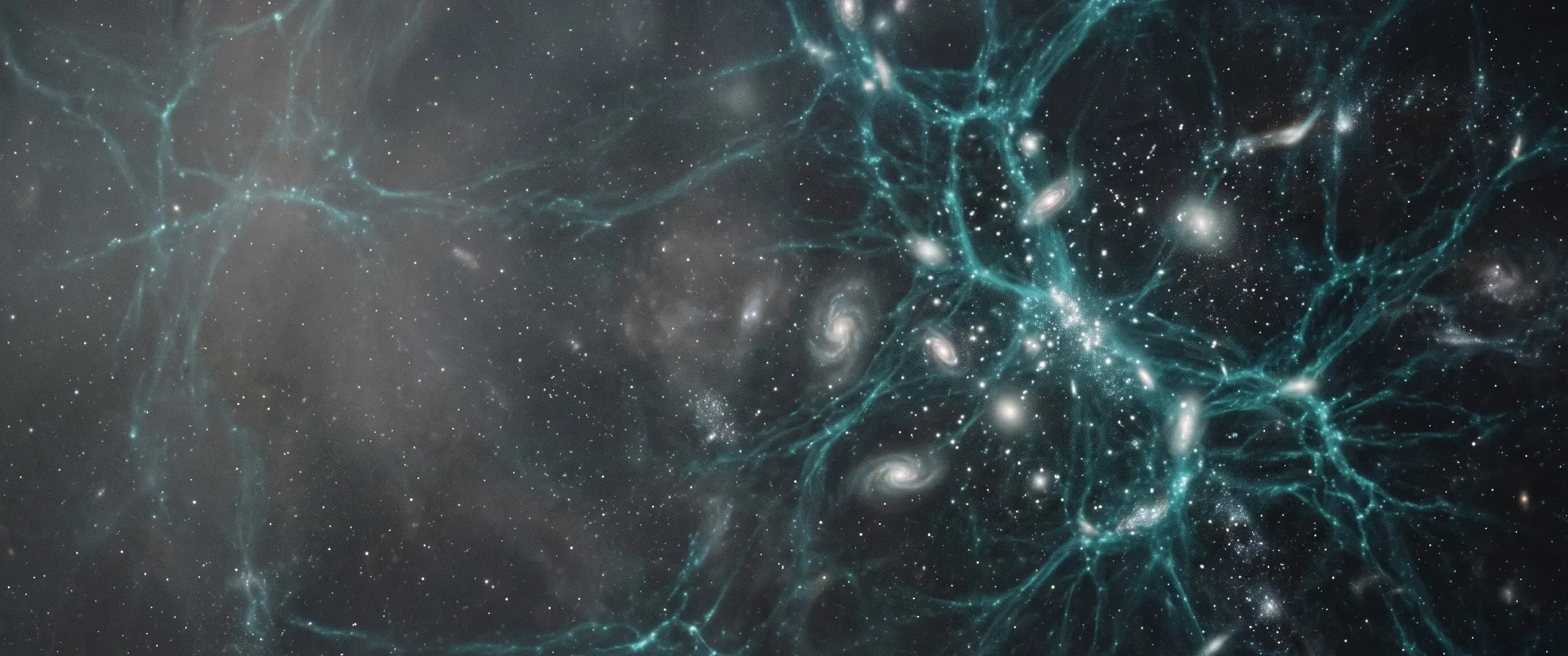
Is dark energy changing its mind? DESI and Einstein's returning 'blunder'
The standard model of cosmology rests on a quiet assumption: that dark energy, whatever is driving the universe apart, is constant, the same yesterday, today, and forever. In March 2025 the DESI collaboration released the largest map of cosmic structure ever assembled, and it hints, without yet proving, that the assumption may be wrong.
The 68 percent we cannot name
Begin with an embarrassment. About 68 percent of everything in the universe (a little over two-thirds of its contents) is dark energy, and we cannot say what it is. It reveals itself only through its effect: the expansion of the universe is not slowing under gravity, as you might expect of a cosmos full of matter pulling on itself, but speeding up. Every galaxy, every atom, every scrap of unseen matter is the minority partner. The majority is a name we gave to our ignorance: “dark energy,” a placeholder for whatever pushes space apart faster and faster. That we can measure the influence of something we cannot identify, reading its presence in the precise way distant galaxies recede, is either the great triumph of modern cosmology or its standing warning, and probably both. The entire enterprise of precision cosmology is, in large part, an effort to pin down the behavior of that name.
Einstein’s returning blunder
The simplest candidate is also the oldest. When Albert Einstein first applied general relativity to the whole universe, he added a term to his equations (the cosmological constant, written Λ) to hold the cosmos static. When the universe turned out to be expanding, he removed the term and, by the famous telling, dismissed it as his “biggest blunder.” Decades later it came back. A cosmological constant behaves exactly like an energy inherent to empty space itself: an unchanging push, the same density everywhere and for all time, so that as the universe grows the total amount of it grows with the volume. That is why today’s reigning model takes its very name from it: ΛCDM, the Λ standing for Einstein’s resurrected constant. The blunder became the leading description of dark energy. DESI’s question is disarmingly simple: is that constant really constant?
A ruler built from the early universe
DESI, the Dark Energy Spectroscopic Instrument, answers by measuring the expansion history directly. It maps millions of galaxies and quasars across billions of light-years, and looks for a subtle, regular spacing imprinted in how they cluster: the baryon acoustic oscillations, or BAO. These are frozen sound waves from the infant universe, pressure ripples that stalled when the cosmos cooled and left a preferred distance between galaxies: a “standard ruler” of known length stamped across the sky. The logic of a standard ruler is the logic of holding a meter stick at arm’s length and then across the room: because you know its true size, its apparent size tells you how far away it is, and how much the space between you and it has stretched. By measuring how that ruler appears at many distances, and therefore at many epochs, DESI reconstructs how fast the universe was expanding at each stage of its life. The second data release, DR2, is described as the largest dataset ever used to measure BAO: its BAO measurements draw on more than 14 million galaxies and quasars, more than twice the size of the DR1 dataset behind the first-year result. (A separate figure, easy to confuse with that one: DESI’s public DR1 catalogue lists some 18.7 million objects in total, among them 13.1 million galaxies and 1.6 million quasars. That is the full catalogue, wider than the sample any BAO fit uses.)
What DR2 actually said
Released on March 19, 2025, DR2 sharpened a hint that had already appeared in DESI’s first year. The collaboration reported that the evidence for a time-evolving dark-energy equation of state increased relative to the Year-1 results. (The equation of state is the single number physicists use to summarize dark energy’s behavior, loosely the relationship between its pressure and its density; a true cosmological constant holds that number fixed for all time, while the fits DESI now favors let it drift.) The preference is not a single measurement but a combination: DESI’s BAO ruler stacked together with the cosmic microwave background (the relic light of the early universe, the baby picture JWST picks up from) and with Type Ia supernovae, the “standard candles” that trace more recent expansion. Within that combination, DESI reports that the evidence for dynamical dark energy at low redshift, in the relatively nearby universe (z < 0.3), is “robust across various methods.” Read at face value, the data suggest dark energy was somewhat stronger in the past and has been weakening since.
Suggestive, not settled
One caveat matters more than any headline. This is a hint that strengthened, not a discovery that landed. Its statistical weight depends on which supernova sample you fold in: the preference for evolving dark energy runs from roughly 2.8σ to 4.2σ depending on whether the Pantheon+, Union3, or DES-SN5YR compilation is combined with DESI and the microwave background. The symbol σ counts standard deviations, a measure of how unlikely a result is to be a mere statistical fluke, and physics reserves the word “discovery” for the 5σ threshold, the point at which a chance explanation becomes vanishingly implausible. Every one of those figures sits below it. So the status is exactly the one DESI uses: the evidence has grown, the signal is intriguing, and it may yet regress to a plain, constant Λ as more data arrive. (The same DESI-plus-CMB combination also pushes the allowed mass of the neutrino to strikingly low values: a separate, roughly 3σ tension that reminds us these datasets are straining several corners of the model at once.)
Why it matters either way
If the signal holds, it is the biggest crack in the standard model of cosmology in a generation, a model that already carries open questions at its earliest moments. A dark energy that changes over time cannot be Einstein’s constant; it would demand new physics, and it would rewrite the universe’s long-term fate, which turns entirely on whether the push is fixed or fading. A cosmos that expands forever, one that coasts, and one that eventually turns around are different endings selected by that one behavior. If instead the signal dissolves back toward a constant, the episode is no less valuable: a case study in how a careful collaboration reports a tantalizing result at its true strength, refusing to promote 4σ into certainty for the sake of a cleaner story. Either outcome will be decided the same way — by more sky. More DESI data, larger supernova samples, and future surveys will either drive the significance past the discovery bar or watch it settle back toward Λ. For now, the most accurate thing to say is also the most interesting one: the universe’s dominant ingredient may not be as changeless as we assumed, and we are, at last, measuring it well enough to find out.
Sources / further reading
- DESI DR2 results guide (March 19, 2025): https://www.desi.lbl.gov/2025/03/19/desi-dr2-results-march-19-guide/
- DESI DR2 Results II: BAO and cosmological constraints (arXiv:2503.14738): https://arxiv.org/abs/2503.14738
- Gu et al., “Dynamical Dark Energy in light of the DESI DR2 Baryonic Acoustic Oscillations Measurements” (arXiv:2504.06118): https://arxiv.org/abs/2504.06118
Written by Ashwin Rajendraprasad for CloudSignal AI.