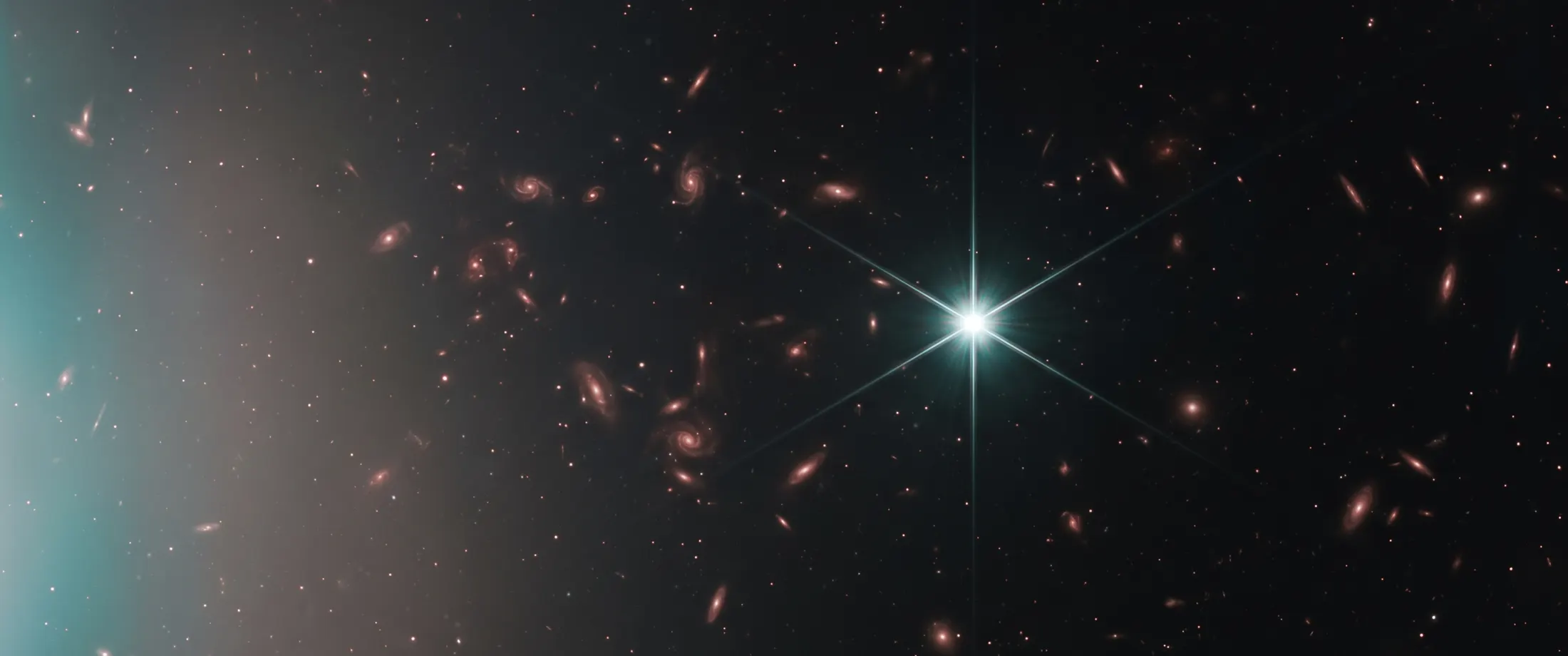
The universe's baby pictures keep getting sharper: JWST at the cosmic dawn
The cosmic microwave background is the universe’s baby picture, taken when it was 380,000 years old. The James Webb Space Telescope is now developing what comes next (the first few hundred million years), and it keeps finding them more crowded, and more grown-up, than the models predicted.
The oldest light, and the dark ages that followed
For its first 380,000 years the universe was an opaque, glowing plasma: too hot for electrons and nuclei to bind, so light could not travel far without scattering off a free electron. When it finally cooled enough for neutral atoms to form, an event cosmologists call recombination, the fog lifted and that light streamed free for the first time. We still catch it today, stretched by billions of years of cosmic expansion into faint microwaves. It is the oldest light there is, and for a long time it was as far back as we could see.
What came after that flash was, paradoxically, dark. Neutral hydrogen filled the cosmos, no stars had yet formed, and nothing shone. Then, over the next few hundred million years, gravity slowly drew the primordial gas into knots dense and hot enough to ignite: the first stars, then the first galaxies, and the universe lit up again. That interval, the cosmic dawn, is the hardest chapter of cosmic history to observe, because its light is both extraordinarily faint and extraordinarily far. It is precisely the chapter Webb was built to read.
Why it takes an infrared telescope
The starlight of those first galaxies set out as ultraviolet and visible light. But space has expanded enormously in the billions of years since, and expansion stretches light along with it, sliding it toward longer, redder wavelengths. By the time the earliest starlight reaches us it has been stretched clean out of the visible band and into the infrared. A telescope hunting the cosmic dawn therefore has to be an infrared telescope, and it has to be kept extraordinarily cold, so that the instrument’s own heat does not drown the whisper it is trying to hear.
That is Webb’s defining design choice, and it is why this telescope, rather than the visible-light observatories before it, is the one that finally reached the dawn. The engineering exists in service of a single ambition: to collect photons that left their galaxies when the universe was a small fraction of its present age, and to do it well enough to not just see those galaxies but weigh them and read their chemistry.
Galaxies that grew up too fast
Here is where the wonder acquires an edge. Before launch, models of galaxy formation made a fairly confident prediction: the earliest galaxies should be small, faint, and rare, because there had simply not been enough time to assemble much. Webb has repeatedly found otherwise. Since its first deep images in 2022, it has turned up galaxies at very high redshift (which is to say, very early) that appear brighter and more massive than the standard timeline comfortably allows. Ivo Labbé and colleagues reported six candidate galaxies carrying more than ten billion suns’ worth of stars just 500 to 700 million years after the Big Bang, and Michael Boylan-Kolchin showed that objects that massive, that early, press against what the standard cosmology permits given the raw material available to build them. Structures that “should” have taken most of a billion years to assemble look as though they managed it in a fraction of that. The candidates still need spectroscopic confirmation one by one, and some have already come down in mass on closer inspection, but the pattern has outlived enough scrutiny to count as a documented tension rather than a one-off anomaly.
The surprise is easy to oversell. This is a tension with our models of how galaxies form, and how quickly — not a crack in the Big Bang itself. The overall framework, a hot dense early universe that expanded and cooled and left the microwave background exactly where theory said it would, is not what is in question; the detailed history of cosmic expansion is being tested and refined by other instruments, such as the DESI galaxy survey, on its own terms. What Webb has put under pressure is the messier, less certain story of how fast raw gas turned into stars in the very first galaxies. The foundations are intact. It is the construction schedule that looks wrong.
Reading a galaxy’s chemistry
Webb does not only count and weigh galaxies; it can also read them, by spreading their infrared light into a spectrum and picking out the fingerprints of individual molecules. In February 2026, astronomers using Webb reported an unusual concentration of small organic molecules deep inside the dust-shrouded core of IRAS 07251-0248, an ultraluminous infrared galaxy in the nearby universe. That is not a cosmic-dawn result, and the distinction is worth keeping straight: what it demonstrates is that Webb’s spectrographs can characterize chemistry through obscuring dust that defeated earlier instruments. Turned on the deep field, the same capability is what lets astronomers ask the chemical question of genuinely early galaxies, where the answer carries a timing signal, since dust and heavy elements have to be forged in stars and scattered by their deaths before they can exist at all.
The range extends closer still. The instrument that reads galaxies billions of light-years away has also sized up the near-Earth asteroid 2024 YR4 in April 2025 and turned its mirror on the interstellar comet 3I/ATLAS, a genuine visitor from another star system, as it passed through. A telescope designed to catch the faintest and oldest light in the cosmos turns out to be just as revealing on the doorstep.
A tension, not a revolution
So what accounts for galaxies that grew up too fast? No one is certain yet, and several possibilities remain open. Star formation may have been more efficient in the first galaxies than it is in the nearby universe; the earliest stars may have been more massive and more luminous, brightening a galaxy without requiring more mass than the timeline allows; or conditions in the young cosmos may have favored rapid assembly in ways the models have not captured. These are live hypotheses, actively argued over, not conclusions.
What makes this era of astronomy so absorbing is the direction of travel. Each generation of instruments pushes the universe’s oldest images a little earlier and a little sharper: from the microwave background’s smooth glow, to the deep fields of earlier telescopes, to Webb’s unexpectedly crowded cosmic dawn. The gap between what we see and what we expected is not a failure of the picture. It is the part of the picture still developing.
Sources / further reading
- Labbé et al., “A population of red candidate massive galaxies ~600 Myr after the Big Bang,” Nature 616, 266 (2023): https://arxiv.org/abs/2207.12446
- Boylan-Kolchin, “Stress testing ΛCDM with high-redshift galaxy candidates,” Nature Astronomy 7, 731 (2023): https://arxiv.org/abs/2208.01611
- NASA, “Webb Delivers Deepest Infrared Image of Universe Yet” (July 12, 2022): https://science.nasa.gov/missions/webb/nasas-webb-delivers-deepest-infrared-image-of-universe-yet/
- NASA, “Webb finds most distant known galaxy” (JADES-GS-z14-0, May 2024): https://science.nasa.gov/blogs/webb/2024/05/30/nasas-james-webb-space-telescope-finds-most-distant-known-galaxy/
- ScienceDaily (Feb 11, 2026), organic molecules in the nearby ultraluminous infrared galaxy IRAS 07251-0248: https://www.sciencedaily.com/releases/2026/02/260211073026.htm
- NASA, James Webb Space Telescope latest news: https://science.nasa.gov/mission/webb/latestnews/
- ESA/Webb news archive: https://esawebb.org/news/
Written by Ashwin Rajendraprasad for CloudSignal AI.