Feynman's path integral: how a particle takes every path at once
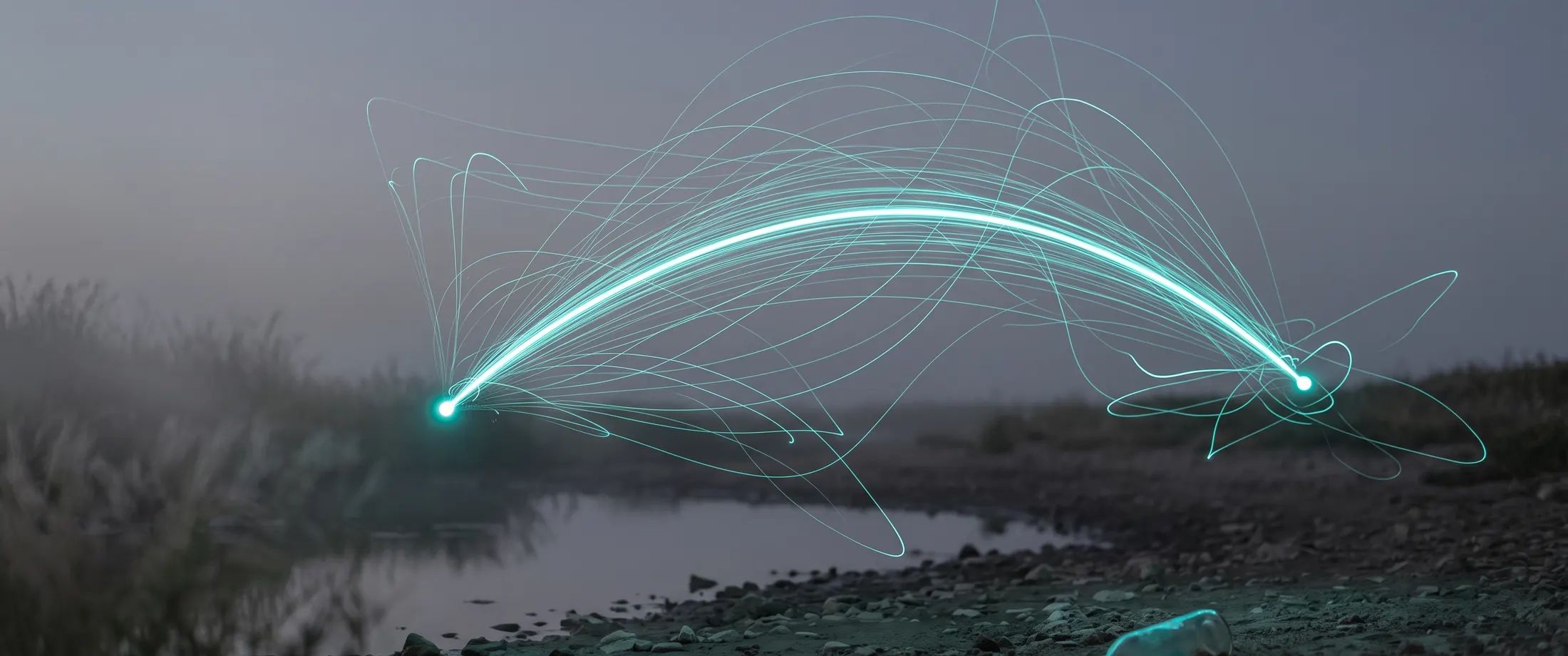
Ask classical physics how a particle gets from A to B and you receive a single answer: the one path nature selects. The reformulation of quantum mechanics that Richard Feynman published in 1948 says the particle takes every path there is, and that adding up all of them, each carrying a phase, reproduces quantum mechanics exactly.
One path, chosen by the action
Classical mechanics rests on an elegant selection rule. Among all the conceivable routes a system might trace between a starting configuration and a final one, the route actually taken is the one that makes a particular quantity stationary: the action, the integral of the Lagrangian (kinetic minus potential energy) along the route. William Rowan Hamilton gave the principle its modern form in 1834, and it is among the most compact statements physics owns: write down the action, demand it be stationary, and the equations of motion follow.
The rule also carries a faint air of teleology. A thrown ball seems to survey the alternatives and select the trajectory of stationary action, as if it knew its destination in advance. How does it know? Classical mechanics offers no reason; it posits the rule, extracts correct predictions from it, and physics went on doing exactly that for a century. The explanation, when it arrived, came from quantum mechanics, where the alternatives a ball appears to survey are routes it genuinely travels, and stationary action falls out of what happens once they are added together.
Dirac’s hint, and a beer party in Princeton
Paul Dirac spotted the first thread in 1933. In a short paper, “The Lagrangian in Quantum Mechanics,” published in the Physikalische Zeitschrift der Sowjetunion, he observed that the quantity carrying a quantum wave function forward by an infinitesimal step in time corresponds to the exponential of the classical action for that step, . He noted the correspondence and left it there.
Feynman picked the thread up eight years later, and told the story in his 1965 Nobel lecture. At a beer party in the Nassau Tavern in Princeton, a physicist newly arrived from Europe, Herbert Jehle, pointed him to Dirac’s paper, and the two read it together the next day. Dirac’s paper claimed only a correspondence, which Feynman, recounting the episode in that lecture, rendered as the two quantities being “analogous”; what he wanted to know was what analogous meant in practice. So he tried the simplest reading, set the two expressions equal up to a constant, and calculated. Out came the Schrödinger equation. What Dirac had left as a correspondence was an equality, and it grew into Feynman’s 1942 Princeton thesis and then the full formulation, published in 1948 as “Space-Time Approach to Non-Relativistic Quantum Mechanics” in Reviews of Modern Physics.
The finished rule fits in one line. The amplitude for a particle to travel from point to point is a sum over every path connecting them:
Here is the classical action evaluated along the path , and is the reduced Planck constant. Every path contributes with the same magnitude; only its phase, the angle of the small complex arrow it adds to the total, differs. Nothing restricts which paths qualify, so a route that loops, backtracks, or detours past the far side of the room enters on the same footing as the sensible one, and the probability of arrival is the squared magnitude of everything added together.
Why the world still looks classical
The sum explains its own invisibility in daily life. For a macroscopic object, the action along any path is colossal compared with , so the phase spins through millions of turns between one path and its near neighbor. Deform the path slightly and its arrow points somewhere entirely different; add the neighbors together and they cancel. The lone exception sits at the stationary point of the action, where, by definition, small deformations change only at second order. There, and only there, neighboring paths arrive with nearly identical phases and reinforce one another. The single classical trajectory is what survives of the sum after everything else has interfered itself away. Hamilton’s principle turns out to be an interference effect: the ball takes every path, and the paths that disagree destroy each other.
The double slit, reduced to bookkeeping
The experiment usually staged to showcase quantum strangeness reads differently in this language. In its textbook form, electrons travel one at a time toward a barrier with two openings and a screen beyond, and the arrivals accumulate into interference stripes. Akira Tonomura and colleagues at Hitachi recorded that buildup in 1989 with a different two-path device, an electron microscope fitted with an electron biprism: a fine charged wire that deflects the halves of the electron wave passing either side of it toward each other, so two virtual sources overlap at the detector. A position-sensitive counter logged the arrivals dot by dot, and the fringes assembled out of individually random single-electron hits. In the sum over histories, the question of which side of the wire the electron passed was never well posed. The amplitude holds the paths that pass on one side and the paths that pass on the other, and the fringes are their bookkeeping, phases reinforcing at some points of the detector and cancelling at others. Block either route and you delete half the sum, and the fringes go with it. Nothing about the electron has to change for that to happen, because the description never contained a fact about which route it took.
Paths a classical particle could never take
The sum also contains trajectories classical mechanics flatly forbids. A particle facing an energy barrier taller than its kinetic energy has, classically, no route to the far side. In Feynman’s sum the barrier-crossing paths are present anyway, and their contributions do not entirely cancel; the residue is quantum tunneling, the effect that lets alpha particles escape nuclei and hydrogen nuclei fuse in the Sun’s core. (Computed carefully, the amplitude is dominated by a path traversed in imaginary time, a mathematical rotation that returns below.) Nor is tunneling confined to the microscopic: the 2025 Nobel Prize in Physics honored the demonstration that an entire superconducting circuit can tunnel through a barrier no classical circuit could cross.
From diagrams to the edge of time
The formalism scaled far beyond single particles. Replace the paths of one particle with the possible histories of a field and the same construction becomes the working language of quantum field theory. Feynman’s contribution to that language was the diagrams that now carry his name, each one shorthand for a single term in the expansion of the sum, a picture standing in for an integral. On 1 February 1949, Freeman Dyson published the proof that the diagrammatic method and the formulations of Julian Schwinger and Sin-Itiro Tomonaga were one theory, seven months before Feynman’s own “Space-Time Approach to Quantum Electrodynamics” reached print that September. The 1965 Nobel Prize went to Feynman, Schwinger and Tomonaga jointly for that body of work, and most calculation in particle physics today is organized as a sum over histories.
The reach extends to cosmology. Rotate time into imaginary values and the oscillating phases become decaying exponentials, far tamer to compute with; that Euclidean form of the path integral is what James Hartle and Stephen Hawking used in 1983 to propose the no-boundary wave function of the universe, a sum not over particle paths but over entire four-dimensional geometries of spacetime. Their proposal remains a leading idea rather than an established result, but the instrument it is written in is Feynman’s.
That may be the most instructive part of the story. Feynman’s 1948 paper shows the sum over histories to be mathematically equivalent to the quantum mechanics of Schrödinger and Heisenberg already in every textbook, and at the time it predicted nothing new; what it changed was what physicists could see. Gauge theories, tunneling calculations, lattice simulations, quantum cosmology: each arrives most naturally in the path-integral language. A reformulation with no new content became the most fertile way of thinking in modern physics, a standing reminder that how you write a theory down is part of the theory.
Sources / further reading
- Feynman, “Space-Time Approach to Non-Relativistic Quantum Mechanics,” Reviews of Modern Physics 20, 367 (1948): https://link.aps.org/doi/10.1103/RevModPhys.20.367
- Dirac, “The Lagrangian in Quantum Mechanics,” Physikalische Zeitschrift der Sowjetunion 3, 64-72 (1933): https://inspirehep.net/literature/44918
- Feynman, “The Development of the Space-Time View of Quantum Electrodynamics,” Nobel lecture (1965): https://www.nobelprize.org/prizes/physics/1965/feynman/lecture/
- Feynman, “Space-Time Approach to Quantum Electrodynamics,” Physical Review 76, 769 (1949): https://link.aps.org/doi/10.1103/PhysRev.76.769
- Dyson, “The Radiation Theories of Tomonaga, Schwinger, and Feynman,” Physical Review 75, 486 (1949): https://link.aps.org/doi/10.1103/PhysRev.75.486
- Tonomura et al., “Demonstration of single-electron buildup of an interference pattern,” American Journal of Physics 57, 117 (1989): https://pubs.aip.org/aapt/ajp/article/57/2/117/1040594/Demonstration-of-single-electron-buildup-of-an
- Hamilton, “On a General Method in Dynamics,” Philosophical Transactions of the Royal Society (1834): https://royalsocietypublishing.org/doi/10.1098/rstl.1834.0017
- Hartle & Hawking, “The Wave Function of the Universe,” Physical Review D 28, 2960 (1983): https://journals.aps.org/prd/abstract/10.1103/PhysRevD.28.2960
Written by Ashwin Rajendraprasad for CloudSignal AI.