The Higgs field: where elementary particles get their mass
Mass looks like something a particle simply has. Nearly every elementary particle gets it instead from a field that fills all of space and has held a nonzero value since the universe’s first trillionth of a second. The boson discovered at CERN in 2012 was a ripple in that field, and its significance was what it proved: the field is really there.
A universe made of fields
The deepest picture modern physics has of reality contains no tiny billiard balls. In quantum field theory, the framework whose electromagnetic version was completed by Sin-Itiro Tomonaga, Julian Schwinger, and Richard Feynman (Nobel Prize, 1965), the basic ingredients of nature are fields: continuous, space-filling quantities, one for each species of particle. An electron is a localized, quantized vibration of the electron field; a photon is the same kind of excitation in the electromagnetic field. Particles are what fields do, the way notes are what strings do. The rules governing those excitations are unforgivingly quantum, and they apply at any scale a system can be kept isolated, as the 2025 Nobel work on tunneling circuits made vivid. Once you accept the field picture, a strange question becomes askable: what is a field’s value in empty space? For nearly every field in nature the answer is zero, since the vacuum is what remains once every excitation has been removed. The Higgs field is the exception, holding a nonzero value there, and it is through that value that elementary particles come to have mass at all.
The problem 1964 was solving
By the early 1960s, the equations describing nature’s forces had acquired a beautiful structure called gauge symmetry, along with a brutal defect: the symmetry demanded that force-carrying particles be exactly massless. For the photon, that was fine. But the weak nuclear force, the one behind radioactive decay, operates only across subatomic distances, and in quantum theory a short-ranged force implies heavy carriers. Writing the masses in by hand wrecked the theory’s predictions. Yoichiro Nambu had already shown that a symmetry can break spontaneously, with the laws staying symmetric while the state of the world does not, an insight carried over from superconductivity that later earned the 2008 Nobel Prize. Yet a theorem due to Jeffrey Goldstone seemed to close that road too: in a relativistic theory, spontaneous breaking always spawns new massless particles that are not observed, trading one disaster for another.
The escape arrived in 1964, in three independent papers in the same volume of Physical Review Letters. Robert Brout and François Englert in August, Peter Higgs in October, and Gerald Guralnik, Carl Hagen, and Tom Kibble in November all found the same loophole: when the broken symmetry is a gauge symmetry, Goldstone’s unwanted massless particles get absorbed, becoming the missing ingredient that renders the force carriers massive. The price is a new field whose value is nonzero everywhere, even in a perfect vacuum. Higgs’s paper added the observation that such a mechanism leaves behind one massive scalar particle, and that remark attached his name to the field and its quantum alike.
A vacuum that prefers not to be empty
Why would a field hold a nonzero value in empty space? Because for this one field, sitting at zero costs energy. Its potential energy density takes the form
where is the value of the Higgs field, is a positive self-interaction strength, and the coefficient is negative. That minus sign is the entire story. It turns the point into the top of a hill, with the true minimum lying at a nonzero field value, measured through the strength of the weak interaction to be about 246 GeV. Empty space is therefore permeated by a fixed, uniform Higgs value, and particles moving through the vacuum interact with it continuously. The strength of each particle’s coupling sets its mass. The top quark couples strongly and is the heaviest known elementary particle, while the electron’s coupling is faint, which is why it is so light. The photon does not couple at all, so it stays massless and travels at the cosmic speed limit. A particle’s mass, on this account, measures how strongly it engages with the vacuum it moves through, fixed by one coupling constant per species acting against the single value the field holds everywhere.
The moment the field switched on
Turning that mechanism into the working heart of a real theory was the next act. Sheldon Glashow, Abdus Salam, and Steven Weinberg used it to unify electromagnetism and the weak force into a single electroweak interaction, work recognized with the 1979 Nobel Prize. In the electroweak theory, the four force carriers begin symmetric and massless. In the searing conditions of the universe’s first instants (an era that sits just downstream of the origin-of-time questions physicists still argue about), temperatures were high enough to pin the Higgs field’s average value at zero, and the full symmetry held. As the universe expanded and cooled, roughly a trillionth of a second after the Big Bang, the field settled into its nonzero minimum and the symmetry broke. Three of the four carriers, the W⁺, W⁻, and Z bosons, became heavy, near 80 and 91 GeV; they were found at CERN in 1983, as heavy as predicted. The fourth stayed massless: the photon. Electrons acquired their mass in the same transition, and with it atoms acquired a size, because a massless electron would bind into no atom at all.
The ripple at 125 GeV
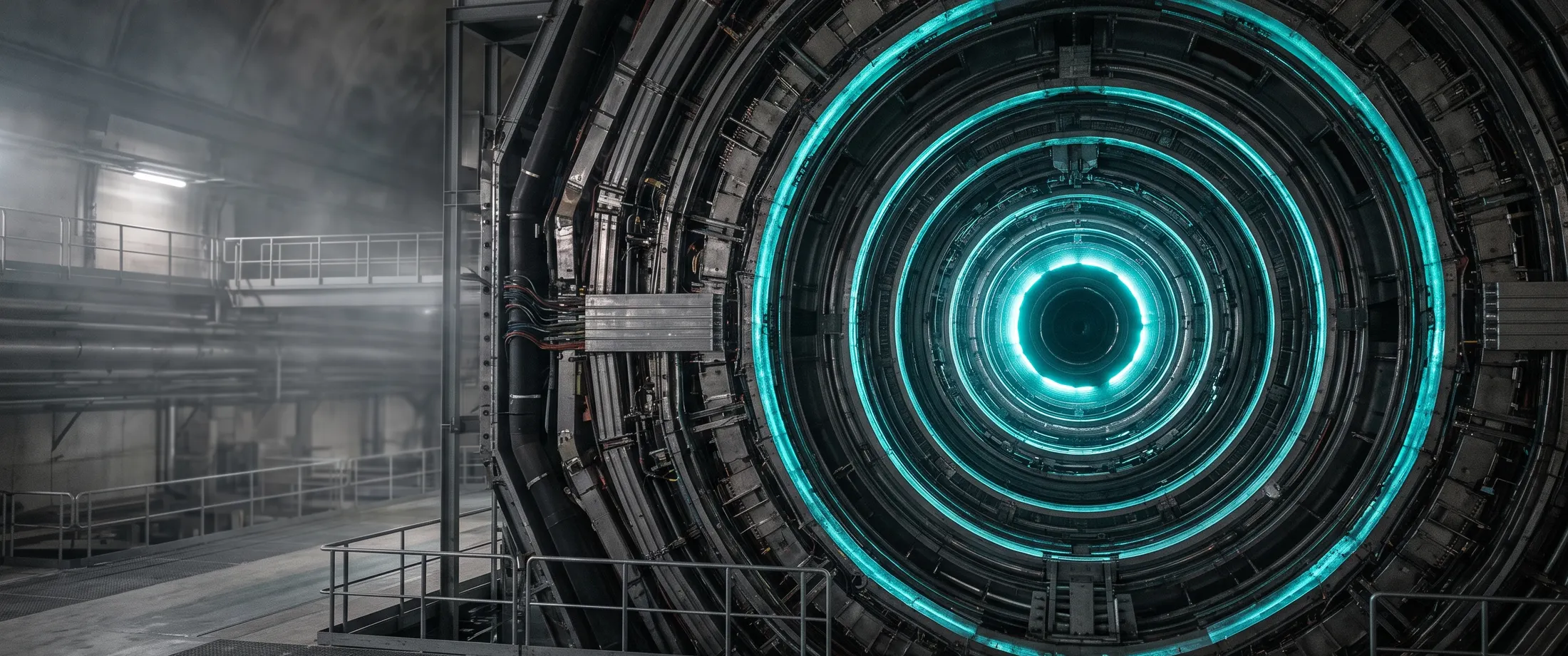
A field that fills the vacuum uniformly is almost perfectly hidden, since stillness cannot be seen. Seeing it at all means striking it hard enough to make it ring. A localized oscillation of the Higgs field is a particle, the Higgs boson, and producing one was the only direct way to prove the field exists. Doing so took the Large Hadron Collider at CERN and two independent collaborations of thousands of physicists, because theory here had to wait on engineering, the way Einstein’s prediction of gravitational waves waited a century for detectors able to register them. On July 4, 2012, the ATLAS and CMS experiments announced a new particle in the mass region around 125 to 126 GeV, each at the five-sigma significance physics demands before it uses the word discovery. The 2013 Nobel Prize went to Englert and Higgs for the theoretical work; Brout had died in May 2011, some fourteen months before the announcement.
The mass the Higgs does not account for
The Higgs mechanism gives mass to the elementary particles: the quarks, the charged leptons such as the electron, the W and Z bosons. It does not supply most of the mass in ordinary matter. A proton weighs about 938 MeV, yet the Higgs-given rest masses of its three constituent quarks add up to roughly one percent of that. The remainder is the confined energy of quarks and gluons bound by the strong nuclear force, an accounting made quantitative by a lattice QCD calculation from Yi-Bo Yang and colleagues in 2018, which apportions the proton’s mass among quark motion, gluon field energy, and subtler quantum contributions. Since protons and neutrons make up nearly all the mass of everything built from atoms, you are, by weight, overwhelmingly strong-force binding energy: Einstein’s read from left to right, energy presenting itself as matter. The Higgs field’s gift is smaller and stranger. It sets the electron’s mass, and with it the size of every atom and the fact that chemistry exists.
For an idea with that reach, the original statement of it was slight: the three 1964 papers run a few pages each, mathematics a patient reader can check by hand. Testing them required a 27-kilometer ring under the French-Swiss border, superconducting magnets colder than deep space, and decades of accelerator engineering. What all of that settled in 2012 is the existence question: the field is there, and the mechanism those papers proposed is the one nature uses. What it left untouched is the arithmetic. The 246 GeV the field holds in empty space is a measured quantity, and so is every coupling that converts it into a particular particle’s mass, the electron’s included. The Higgs answers where mass comes from without saying why it arrives in the amounts it does.
Sources / further reading
- F. Englert and R. Brout, “Broken Symmetry and the Mass of Gauge Vector Mesons,” Physical Review Letters 13, 321 (1964): https://link.aps.org/doi/10.1103/PhysRevLett.13.321
- P. W. Higgs, “Broken Symmetries and the Masses of Gauge Bosons,” Physical Review Letters 13, 508 (1964): https://link.aps.org/doi/10.1103/PhysRevLett.13.508
- G. S. Guralnik, C. R. Hagen, and T. W. B. Kibble, “Global Conservation Laws and Massless Particles,” Physical Review Letters 13, 585 (1964): https://link.aps.org/doi/10.1103/PhysRevLett.13.585
- CERN, “CERN experiments observe particle consistent with long-sought Higgs boson,” press release (2012): https://home.cern/cern-experiments-observe-particle-consistent-with-long-sought-higgs-boson/
- NobelPrize.org, “The Nobel Prize in Physics 2013,” press release (2013): https://www.nobelprize.org/prizes/physics/2013/press-release/
- NobelPrize.org, “The Nobel Prize in Physics 1979,” summary: https://www.nobelprize.org/prizes/physics/1979/summary/
- Y.-B. Yang et al. (χQCD Collaboration), “Proton Mass Decomposition from the QCD Energy Momentum Tensor,” Physical Review Letters 121, 212001 (2018), via APS Physics: https://physics.aps.org/articles/v11/118
Written by Ashwin Rajendraprasad for CloudSignal AI.