Pulsars: dead stars that keep the universe's best time
The most reliable clocks in the universe are corpses. When a massive star dies, its core collapses into a city-sized sphere that can spin hundreds of times a second with such steadiness that astronomers now use these dead stars to keep time across the galaxy, and to feel spacetime itself flex.
A signal too regular to be natural
In 1967, Jocelyn Bell Burnell, then a graduate student at the University of Cambridge, was operating a radio telescope she had helped build at the Mullard Radio Astronomy Observatory: four and a half acres of posts, dipoles and cable, designed by her supervisor Antony Hewish to pick out quasars by the way compact radio sources shimmer as their emission crosses the turbulent solar wind. The array wrote the sky onto ninety-six feet of chart paper a day, and Bell Burnell analyzed every foot of it by eye. Six or eight weeks into the survey, by her own account, she became aware of a small patch of what she called “scruff” on the records, and realized it had shown up before, from the same patch of sky. The earliest such trace is dated 6 August 1967, though nothing about it then suggested pulses. On 28 November 1967 a high-speed recording resolved the scruff into a string of pulses one and a third seconds apart, a regularity no known celestial object could produce.
For a few weeks an artificial origin was taken seriously enough that the team labeled the source LGM-1, for “little green men.” The joke retired itself when Bell Burnell found a second pulsing source in a different part of the sky, then two more: whatever these objects were, they were a natural population. The discovery paper, published in Nature in February 1968, announced the first pulsar under the catalogue name CP 1919, known today as PSR B1919+21.
Lighthouses made of collapsed matter
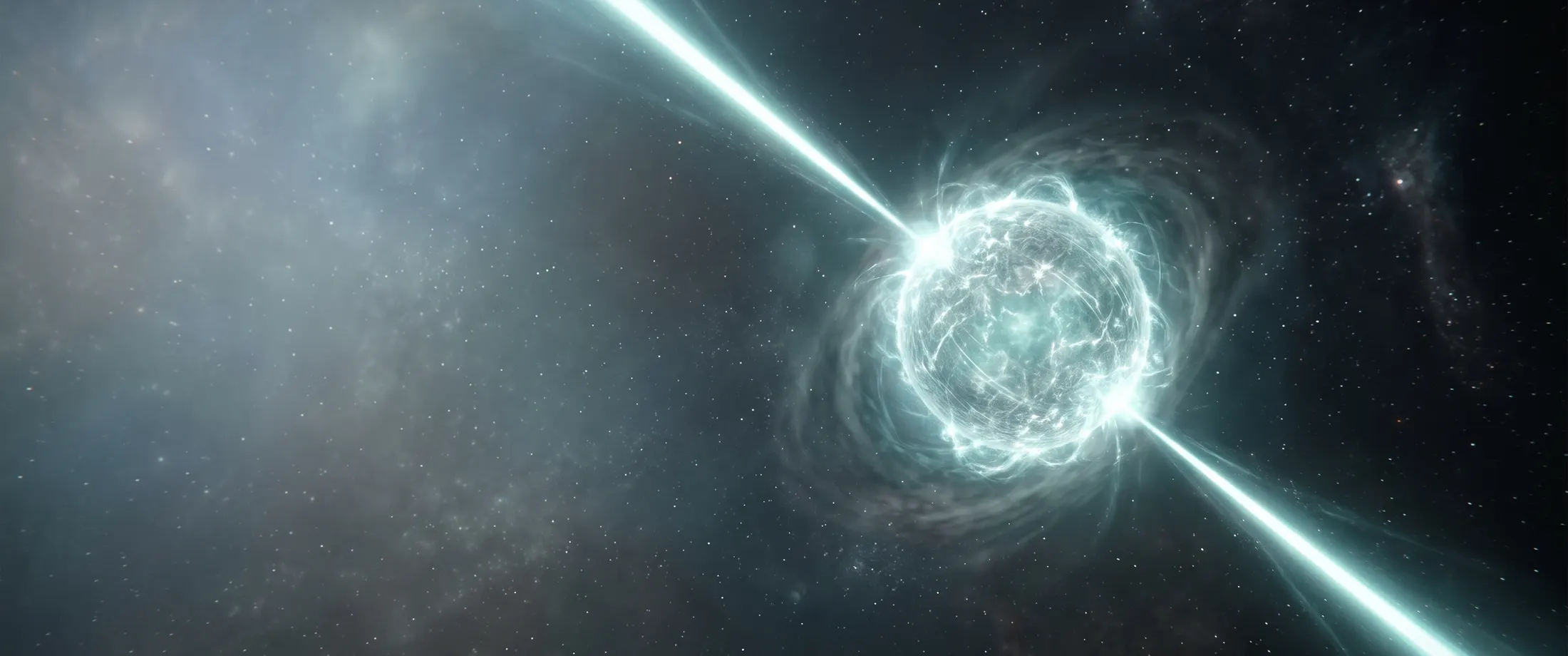
The explanation was nearly on the shelf. In November 1967, after the scruff had begun appearing on Bell Burnell’s charts and before the high-speed recording resolved it, Franco Pacini proposed in Nature that a rapidly rotating, highly magnetized neutron star could power the Crab Nebula; in 1968 Thomas Gold argued, in the same journal, that the new pulsing sources were exactly such objects. A neutron star’s magnetic axis need not align with its spin axis, so radio emission beamed from the magnetic poles sweeps the sky like a lighthouse beam, and each pass across our line of sight registers as one pulse.
A neutron star is the collapsed core of a massive star that died in a supernova: typically about 1.4 times the Sun’s mass compressed into a sphere roughly 20 kilometers across, matter so dense that a sugar cube of it would weigh about a billion tons. The fast spin follows from conservation of angular momentum. For a spinning sphere,
where is the angular momentum, the moment of inertia, the rotation rate, the mass and the radius. With and essentially fixed during collapse, scales as : shrink the core a thousandfold and it spins a millionfold faster, the figure skater’s pulled-in arms performed at stellar scale. A rotating mass that dense is also extraordinarily hard to perturb, which is why the spin, once set, makes so nearly perfect a metronome.
The prize that missed the discoverer
The 1974 Nobel Prize in Physics, the first ever awarded for astronomical research, went jointly to Martin Ryle and Antony Hewish, with Hewish cited “for his decisive role in the discovery of pulsars.” Bell Burnell, who had noticed the signal and pressed the case that it was real, was not included, and the omission has been debated in the scientific community ever since. In 2018 the Breakthrough Prize Foundation awarded her a Special Breakthrough Prize in Fundamental Physics for the discovery of pulsars and a lifetime of scientific leadership. She gave the entire $3 million award to the Institute of Physics, which administers it as the Bell Burnell Graduate Scholarship Fund for graduate students from groups under-represented in physics.
Recycled into millisecond clocks
A young pulsar spins a few times a second and gradually slows. In 1982, Donald Backer, Shrinivas Kulkarni and their collaborators found something that broke the pattern: PSR B1937+21, pulsing 642 times per second. The explanation, proposed the same year by Ali Alpar, Andrew Cheng, Malvin Ruderman and Jacob Shaham, is recycling: in a binary system, an ancient neutron star can be spun back up by matter streaming off its companion, then re-emerge as a millisecond pulsar with a weakened magnetic field and an astonishingly stable rotation. Timed patiently over years, the best of them approach the long-term stability of atomic clocks, which is what makes a pulsar usable as a measuring instrument. The current record holder, PSR J1748-2446ad in the globular cluster Terzan 5, turns 716 times per second (Jason Hessels and colleagues, 2006), fast enough that a point on its equator moves at roughly a quarter of the speed of light.
The orbit that vindicated Einstein
In 1974 Russell Hulse and Joseph Taylor, surveying with the Arecibo telescope, discovered PSR B1913+16, a pulsar locked in a 7.75-hour orbit with another neutron star. General relativity makes a sharp prediction for such a pair: the orbit must shed energy as gravitational waves and shrink at a calculable rate. Because one member is a precision clock, the orbit could be tracked finely enough to check, and by 1978 Taylor had confirmed that the decay matched the general-relativistic prediction. It was the first solid evidence, decades before interferometers caught a wave directly, that gravitational radiation is real. The 1993 Nobel Prize honored Hulse and Taylor “for the discovery of a new type of pulsar, a discovery that has opened up new possibilities for the study of gravitation.”
A detector the size of a galaxy
Instruments like LIGO listen for gravitational waves that oscillate many times a second. The slowest waves, with periods of years to decades, are expected from pairs of supermassive black holes orbiting one another after their host galaxies merge, and no detector buildable on Earth has arms long enough to catch them. Pulsar timing arrays solve the problem by building nothing: they treat dozens of millisecond pulsars scattered across the galaxy as the arms of a single instrument. A passing wave stretches and squeezes the space the pulses cross, nudging arrival times early in one part of the sky and late in another, in a distinctive correlation pattern derived in 1983 by Ron Hellings and George Downs. In June 2023 the NANOGrav collaboration reported evidence for exactly this pattern in 15 years of timing data, with parallel announcements from European, Indian, Australian and Chinese timing-array teams: a nanohertz gravitational-wave background washing over the galaxy. The leading interpretation is the combined hum of supermassive black hole binaries across cosmic time, though the origin is not yet settled and the signal sits at roughly 3σ to 4σ, short of the 5σ bar the field treats as a detection.
Dozens of millisecond pulsars scattered across the galaxy are now timed together as a single detector, one whose components were catalogued decades before anyone proposed the use. The clocks are the part no longer in doubt: a pulsar in a binary orbit proved steady enough to show that orbit shrinking at the rate general relativity predicts for a system losing energy to gravitational waves. A wave with a period of years cannot be hurried, so what the nanohertz background turns out to be will be decided by patience more than by engineering.
Sources / further reading
- A. Hewish, S. J. Bell, J. D. H. Pilkington, P. F. Scott, and R. A. Collins, “Observation of a Rapidly Pulsating Radio Source,” Nature 217 (1968): https://www.nature.com/articles/217709a0
- S. J. Bell Burnell, “Little Green Men, White Dwarfs or Pulsars?” (her 1977 “Petit Four” address, Annals of the New York Academy of Sciences 302), Cosmic Search 1, no. 1 (1979): https://www.bigear.org/vol1no1/burnell.htm
- T. Gold, “Rotating Neutron Stars as the Origin of the Pulsating Radio Sources,” Nature 218 (1968): https://www.nature.com/articles/218731a0
- Nobel Foundation, “The 1974 Nobel Prize in Physics” (press release), NobelPrize.org (1974): https://www.nobelprize.org/prizes/physics/1974/press-release/
- Breakthrough Prize Foundation, “Special Breakthrough Prize in Fundamental Physics Awarded to Jocelyn Bell Burnell for Discovery of Pulsars,” Breakthrough Prize (2018): https://breakthroughprize.org/News/45
- M. Banks, “Jocelyn Bell Burnell to support diversity in physics with $3m winnings from major prize,” Physics World (2018): https://physicsworld.com/a/jocelyn-bell-burnell-to-support-diversity-in-physics-with-3m-winnings-from-major-prize/
- D. C. Backer, S. R. Kulkarni, C. Heiles, M. M. Davis, and W. M. Goss, “A millisecond pulsar,” Nature 300 (1982): https://www.nature.com/articles/300615a0
- R. A. Hulse and J. H. Taylor, “Discovery of a pulsar in a binary system,” The Astrophysical Journal 195 (1975): https://ui.adsabs.harvard.edu/abs/1975ApJ…195L..51H/abstract
- Nobel Foundation, “The 1993 Nobel Prize in Physics” (press release), NobelPrize.org (1993): https://www.nobelprize.org/prizes/physics/1993/press-release/
- G. Agazie et al. (NANOGrav Collaboration), “The NANOGrav 15 yr Data Set: Evidence for a Gravitational-wave Background,” The Astrophysical Journal Letters 951, L8 (2023): https://iopscience.iop.org/article/10.3847/2041-8213/acdac6
Written by Ashwin Rajendraprasad for CloudSignal AI.