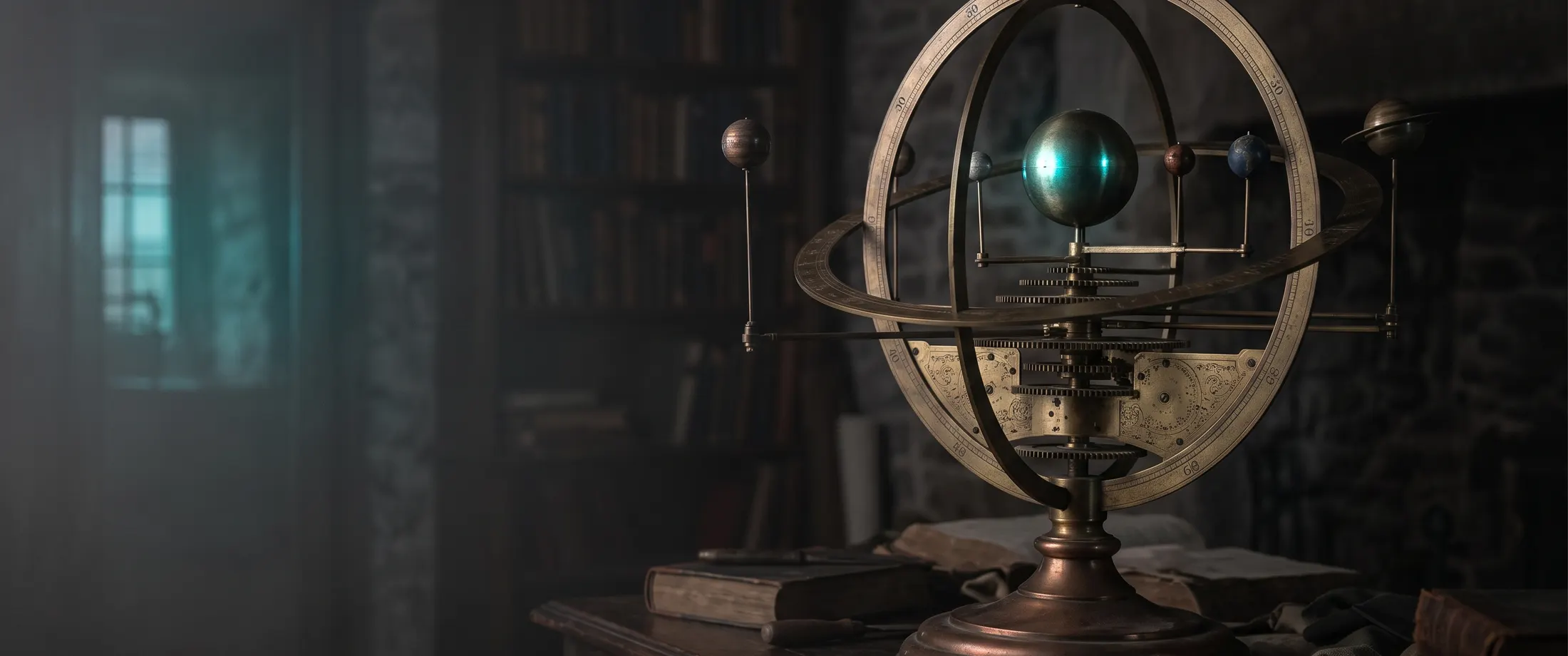
Laplace's demon: the clockwork universe and how it broke
In 1814, Pierre-Simon Laplace pushed Newtonian physics to its logical endpoint: a vast intellect that, given every position and every force in nature at one instant, would see the entire future and past laid open. Two centuries of physics tore that idea down twice, for two unrelated reasons, and the pattern of the wreckage marks out precisely where prediction still works and where it never will.
The cosmos as machine
Isaac Newton’s laws of motion and gravitation (Principia, 1687) recast the heavens as a mechanism: specify where everything is and how it moves, apply the laws, and the state of the system at any other moment follows. Laplace spent a career making good on that promise. His five-volume Traité de mécanique céleste (published between 1798 and 1825) gathered a century of celestial mechanics into one mathematical edifice and argued that the solar system’s apparent irregularities, such as the slow drifts in the orbits of Jupiter and Saturn, were long-period oscillations that correct themselves. The machine did not merely run; in his analysis, it was stable.
A famous story has Napoleon asking why the great book never mentioned God, and Laplace replying that he had no need of that hypothesis. The story’s exact wording is undocumented, and Laplace reportedly asked that it be left out of accounts of his life, so it stands as thin evidence for anything he actually said. The ambition it captures needs no anecdote, and runs through the whole Traité: a universe closed under its own equations, with nothing left over.
The demon, stated precisely
Laplace spelled the ambition out in A Philosophical Essay on Probabilities (1814). In the Truscott and Emory translation: given for one instant “an intelligence which could comprehend all the forces by which nature is animated and the respective situation of the beings who compose it,” an intelligence “sufficiently vast to submit these data to analysis,” it “would embrace in the same formula the movements of the greatest bodies of the universe and those of the lightest atom; for it, nothing would be uncertain and the future, as the past, would be present to its eyes.” Laplace called it simply an intelligence. The nickname “Laplace’s demon” was attached by later writers.
Notice the two requirements. The demon needs perfect input (the exact position and momentum of every particle) and unlimited analysis (the power to integrate the equations without error). Probability, on this view, is bookkeeping for human ignorance rather than a feature of the world, a working convenience that an observer holding the full ledger would have no use for.
First blow: the input does not exist
Quantum mechanics broke the demon at the level of principle. In 1926, Max Born proposed in “Zur Quantenmechanik der Stoßvorgänge” (Zeitschrift für Physik), in a soon-famous footnote, that Schrödinger’s wave function does not say where an electron is; its squared magnitude gives the probability of finding it there. That probability is the complete story the theory offers, with nothing more definite underneath, a step recognized by the 1954 Nobel Prize in Physics for the statistical interpretation of the wave function.
A year later, Werner Heisenberg’s uncertainty paper (Zeitschrift für Physik, 1927) removed the demon’s input at the source: position and momentum cannot both be sharp at once. Later that year, Earle Kennard proved the exact inequality in terms of standard deviations,
where is the spread in position, the spread in momentum, and the reduced Planck constant. The bound is a theorem about the theory’s own mathematics, and it holds however fine the apparatus. In quantum mechanics, the position and momentum descriptions of a particle are Fourier transforms of each other (the mathematics, after Joseph Fourier, of writing a signal as a sum of waves). A wave packet sharply localized in space must be built from a broad band of wavelengths, and wavelength encodes momentum; squeeze either description and the other necessarily spreads. The demon’s first requirement therefore asks for a state the theory never defines. Nor is any of this confined to atoms: the 2025 Nobel Prize honored experiments in which a circuit you can hold in your hand tunneled through a classically forbidden barrier.
Second blow: the input cannot be used
The second demolition needed no quantum mechanics at all. In 1890, Henri Poincaré published “Sur le problème des trois corps et les équations de la dynamique” (Acta Mathematica 13), the memoir that won the prize competition sponsored by King Oscar II of Sweden and Norway. It showed that three gravitating bodies, pure Newtonian clockwork, can move in ways so tangled that no closed-form solution captures them, with trajectories exquisitely sensitive to their starting points. The version the world eventually read was the second one. The prize memoir had already been printed and copies distributed when, on the last day of November 1889, Poincaré wired his editor to stop the presses: he had found a serious error. The copies were recalled and the edition destroyed, Poincaré paid the printing bill himself (over 3,500 kronor, more than the prize money he had received), and the repair he wrote for the replacement is what forced the tangled geometry, now regarded as the first mathematical description of chaos, into view.
In 1963, Edward Lorenz, a meteorologist at MIT, made the sensitivity quantitative. “Deterministic Nonperiodic Flow” (Journal of the Atmospheric Sciences) studied a stripped-down, fully deterministic model of atmospheric convection, just three equations, and found that “slightly differing initial states can evolve into considerably different states.” Errors in the initial data grow exponentially, so each added digit of measurement precision buys only a fixed extra increment of forecast time. Lorenz’s 1972 AAAS talk, “Predictability: Does the Flap of a Butterfly’s Wings in Brazil Set Off a Tornado in Texas?” (a title supplied by session organizer Philip Merilees), gave the phenomenon its permanent name. Determinism in principle, Lorenz showed, does not deliver predictability in practice. The gap between exact microscopic laws and what can actually be computed is the territory where statistical reasoning takes over, the same territory in which entropy and the arrow of time emerge from reversible equations.
The demon’s own solar system
The sharpest irony arrived by computer. In 1989, the astronomer Jacques Laskar published “A numerical experiment on the chaotic behaviour of the Solar System” (Nature): integrating the planets’ averaged equations of motion over 200 million years, he found that the inner solar system is chaotic, with a Lyapunov time of roughly 5 million years. Uncertainty in the planets’ positions grows about tenfold every 10 million years, so an error of 15 meters today becomes 150 million kilometers, a full astronomical unit, after 100 million years. Laplace’s own exemplar of clockwork stability turns out to be a chaotic system on long timescales.
Determinism with a domain
The two demolitions are independent, and they are not of the same kind. Quantum mechanics denied the demon its input in principle, since the sharp joint state it assumes is one the theory never defines. Chaos left the input perfectly lawful and still unusable: any finite error, and every measurement carries one, is amplified until the forecast dissolves. One failure concerns what a state can be, the other what can be done with it, and either alone would have been fatal.
What chaos imposes is a budget rather than a ban. The horizon belongs to the system’s own dynamics, and no computer, however large, moves it more than marginally, so determinism survives as an excellent approximation with an explicit domain: systems whose predictability horizon is long compared to the question being asked. Ephemerides and spacecraft trajectories live inside that domain; weather beyond a couple of weeks lives outside it, and the individual quantum event was never inside. Physics has since learned to treat information itself as a physical quantity with its own accounting, most sharply at the event horizons of black holes. The demon’s obituary, read across both failures, marks the moment prediction acquired error bars, and the error bars turned out to be laws.
Sources / further reading
- Pierre-Simon Laplace, “A Philosophical Essay on Probabilities,” trans. Truscott & Emory, Wiley (1814; trans. 1902): https://archive.org/details/philosophicaless00lapliala
- Pierre-Simon Laplace, “Traité de mécanique céleste,” 5 vols. (1798–1825): https://archive.org/details/traitdemcani01lapl
- Max Born, “Zur Quantenmechanik der Stoßvorgänge,” Zeitschrift für Physik 37, 863–867 (1926): https://link.springer.com/article/10.1007/BF01397477
- Werner Heisenberg, “Über den anschaulichen Inhalt der quantentheoretischen Kinematik und Mechanik,” Zeitschrift für Physik 43, 172–198 (1927): https://link.springer.com/article/10.1007/BF01397280
- Earle H. Kennard, “Zur Quantenmechanik einfacher Bewegungstypen,” Zeitschrift für Physik 44, 326–352 (1927): https://link.springer.com/article/10.1007/BF01391200
- Henri Poincaré, “Sur le problème des trois corps et les équations de la dynamique,” Acta Mathematica 13 (1890), open-access scans of the full memoir: https://projecteuclid.org/journals/acta-mathematica/volume-13/issue-1-2
- “From Order to Chaos: The Prize Competition in Honour of King Oscar II,” Institut Mittag-Leffler (prize history, the recalled printing, and the destroyed edition): https://www.actamathematica.org/library/prize-competition/
- Edward N. Lorenz, “Deterministic Nonperiodic Flow,” Journal of the Atmospheric Sciences 20, 130–141 (1963): https://journals.ametsoc.org/view/journals/atsc/20/2/1520-0469_1963_020_0130_dnf_2_0_co_2.xml
- Jacques Laskar, “A numerical experiment on the chaotic behaviour of the Solar System,” Nature 338, 237–238 (1989): https://www.nature.com/articles/338237a0
Written by Ashwin Rajendraprasad for CloudSignal AI.